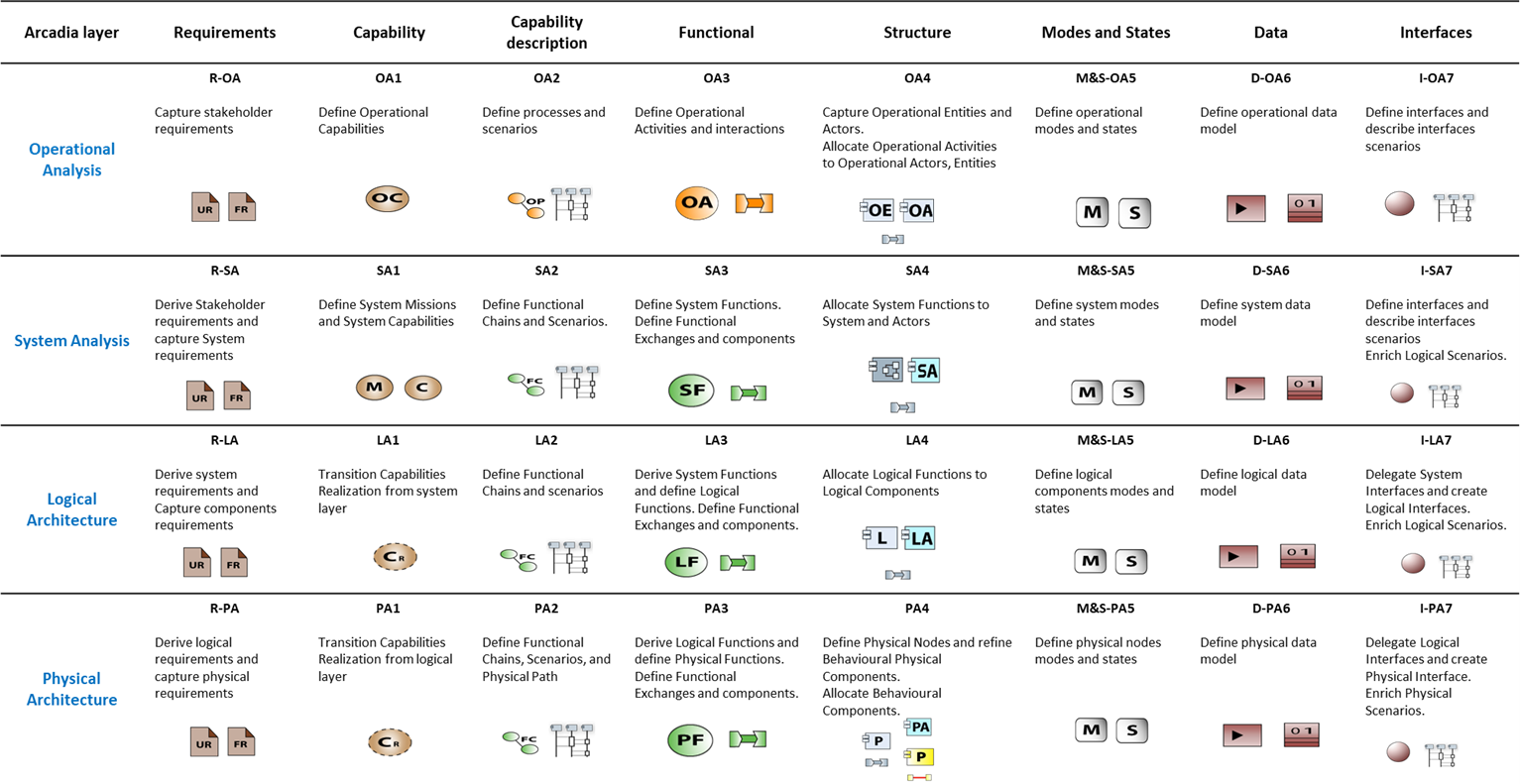
Arcadia is a tooled method devoted to systems & architecture engineering, supported by Capella modelling tool.
It describes the detailed reasoning to
It can be applied to complex systems, equipment, software or hardware architecture definition, especially those dealing with strong constraints to be reconciled (cost, performance, safety, security, reuse, consumption, weight…).
It is intended to be used by most stakeholders in system/product/software or hardware definition and IVVQ as their common engineering reference and collaboration support.
Arcadia stands for ARChitecture Analysis and Design Integrated Approach.
A series of online documents to dive into the principles and concepts of Arcadia:
Arcadia is a system engineering method based on the use of models, with a focus on the collaborative definition, evaluation and exploitation of its architecture.
This book describes the fundamentals of the method and its contribution to engineering issues such as requirements management, product line, system supervision, and integration, verification and validation (IVV). It provides a reference for the modeling language defined by Arcadia.
Jean-Luc Voirin, leader of the creation of the Arcadia method, along with some of the leaders on developing and deploying MBSE Arcadia & Capella practices in Thales. From right to left: Pierre Nowodzienski, Jean-Luc Voirin, Juan Navas, Stephane Bonnet, Frederic Maraux, Gerald Garcia, Philippe Fournies, Eric Lepicier.
Architecture as prime engineering driver
Arcadia, a model-based engineering method
Noticeable features of Arcadia
Definition of the Problem - Customer Operational Need Analysis
Formalization of system requirements - System Need Analysis
Development of System Architectural Design - Logical Architecture (Notional Solution)
Development of System Architecture - Physical Architecture
Formalize Components Requirements - Contracts for Development and IVVQ
Co-Engineering, Sub-Contracting and Multi-Level Engineering
Adaptation of Arcadia to Dedicated Domains, Contexts, Etc.
Equivalences and Differences between SysML and Arcadia/Capella
Many Muslims also recite the following after completing the Quran:
Maintain physical and spiritual cleanliness by performing ablution before beginning the final chapters and the Dua.
While some scholars debate the specific communal Dua after every Taraweeh, the majority of scholars agree that making Dua individually after completing the Quran is highly recommended and supported by the actions of khatmul quran pdf
Completing the recitation of the entire Quran is a monumental spiritual milestone for any Muslim. Known as , this achievement is celebrated with deep gratitude, reflection, and specific supplications.
Mosques and online groups use shared PDFs to coordinate Sabaq (daily portions). The PDF can be printed and hung on a wall, allowing each member to sign off when they finish their assigned Juz. Many Muslims also recite the following after completing
Most specialized Khatmul Quran PDFs do not just end at Surah An-Nas. They include the famous (the completion supplication) right at the end of the file. This ensures you have the exact Arabic text and translations ready the moment you finish. 3. Text Customization
: Acknowledging the completion as a gift from the Divine. Mosques and online groups use shared PDFs to
I can guide you toward the exact resources that match your specific spiritual goals. Share public link
A is more than just a digital file; it is a practical tool designed to elevate your worship, streamline your spiritual goals, and facilitate your connection with the Words of Allah. By incorporating a digital tracker and a clear translation of the final completion Dua into your daily routine, you can approach your next Khatm with focus, understanding, and profound devotion.