

, a man who returns to his secluded hometown with his wife, Manami, only to be dragged back into the village’s disturbing traditional rituals.
: The central conflict revolves around serving and appeasing Kagachi-sama, an ancient entity demanding extreme sacrifices from the villagers. Why the Remaster Matters
The game has been praised for its atmospheric storytelling, intricate character designs, and the way the remaster preserves the original’s eerie tone while making it more accessible to modern audiences.
For those unfamiliar with the series, Kagachi-sama Onagusame Tatematsurimasu, also known as "Kagachi-sama," is a Japanese light novel series written by Kagami Takaya and illustrated by Hikaru Mizuki. The story revolves around Shigure Kagachi, a seemingly ordinary high school student who becomes the unwitting host to a powerful, ancient deity known as Onigusame. As Shigure navigates his daily life with Onigusame's influence, he finds himself entangled in a web of supernatural events and adventures. Kagachi-sama Onagusame Tatematsurimasu Remaster...
The story dives into isolated village customs, psychological manipulation, and the tragic intersection of ancient deities and human frailty. Core Narrative and Themes
The narrative of Kagachi-sama Onagusame Tatematsurimasu is a dark exploration of trauma, desire, and the loss of innocence.
For many years, non-Japanese speakers could only experience the 2012 game via unofficial translation patches, which were often incomplete. However, in 2024 and 2025, the situation finally changed, bringing the game into the global spotlight with what many fans are calling the definitive "Remaster" release. , a man who returns to his secluded
: As the subtitle Netorare Mura In'yabanashi ("The Lewd Tale of the Netorare Village") implies, the narrative utilizes heavy psychological distress themes. The plot follows an outsider or a vulnerable couple entering the village, only to find themselves ensnared by the locals. Under the guise of religious rituals, fertility rites, and appeasing Kagachi-sama, the female protagonist or heroines are subjected to systemized infidelity and manipulation, forcing the male protagonist to witness or endure psychological ruin. The Remaster Edition: What Changed?
The most notable development is the official English version. Known as Cult of the Serpent: Cuck or Be Cucked , this is the official remaster and is published by FAKKU (the largest English hentai publisher) in collaboration with the original developer, Orcsoft.
| Feature | Original (2014) | Remaster (2025) | |---|---|---| | Resolution | 720p | 4K (3840 × 2160) | | Audio | FM synthesis BGM, limited sfx | Full orchestral score, 3‑D positional audio | | Voice Acting | None (text‑only) | Full Japanese voice cast, optional English subtitles | | UI | Static menus | Dynamic, customizable UI with themes | | Save System | Manual save slots | Auto‑save, quick‑load, cloud sync | | Accessibility | Minimal | Text‑to‑speech, color‑blind mode, adjustable text speed | For those unfamiliar with the series, Kagachi-sama Onagusame
Japanese title : 鏡様お亡くなりたむまつります リマスター Genre : Visual novel / Adventure Original developer : Moonlight Studio Remaster developer : Moonlight Studio & Kuroi Interactive Original release : 2014 (Windows) Remaster release : 2025 (Windows, Nintendo Switch, PlayStation 5, Xbox Series X/S) Director : Haruka Mizuki Writer : Ryo Tanaka Composer : Yui Kisaragi
The remastered version updates the classic experience for modern operating systems, ensuring compatibility, sharper visual assets, and smoother UI performance. What is Kagachi-sama Onagusame Tatematsurimasu?


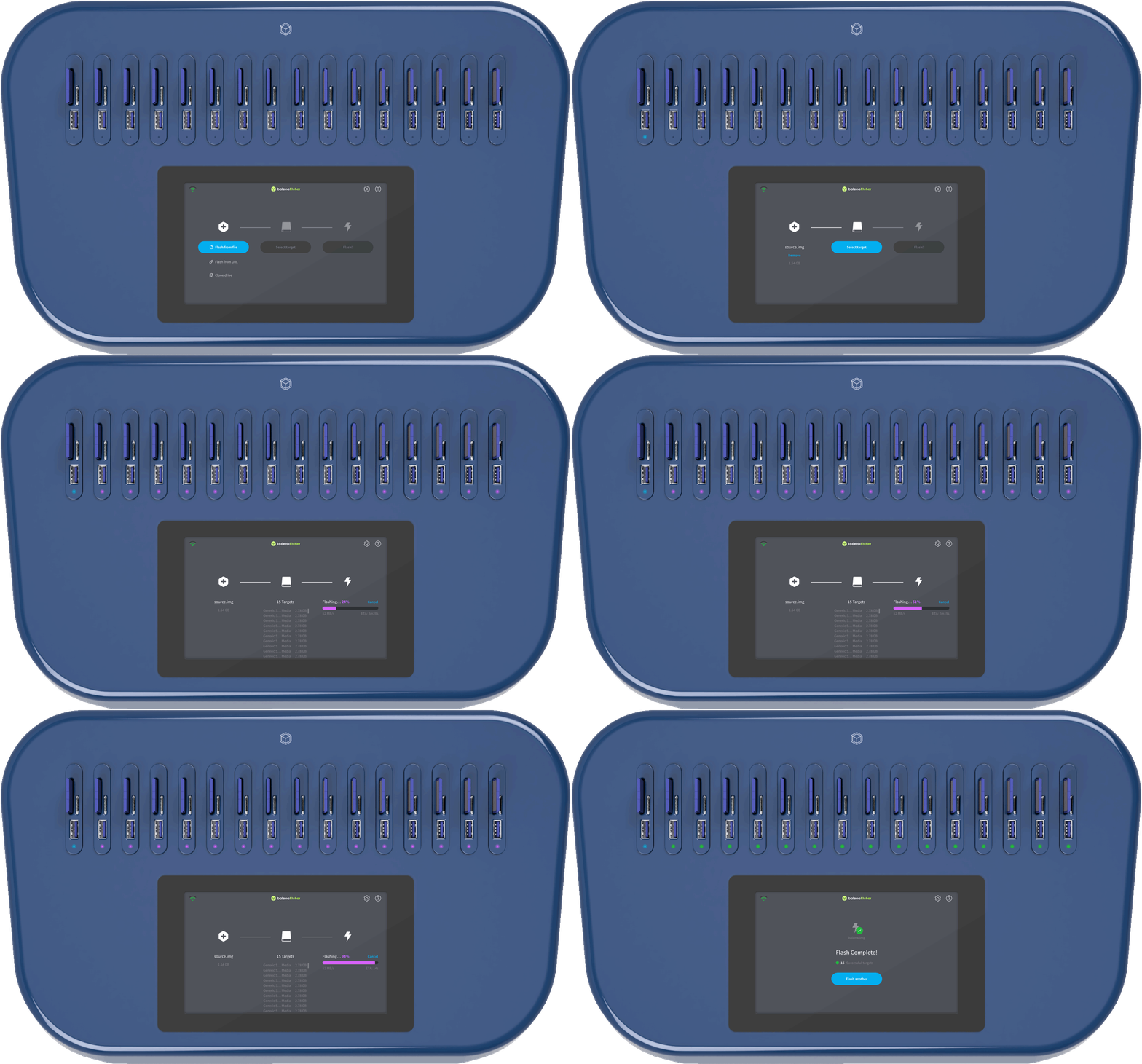
Every EtcherPro can flash up to 16 drives at a time if you are flashing from an online source. If you are flashing from a physical drive, you would be flashing up to 15 drives at a time, as the first slot would serve as the source. In the daisy-chaining scenario, you would only require one slot to serve as a source to flash the entire stack, when flashing from a physical drive.
EtcherPro offers USB (type A), SD and microSD interfaces by default, so you can flash up to 16 different drives / devices simultaneously. For instance, you can flash a balenaFin, a USB drive, an SD card and a microSD at the same time, as long as there is only one target per slot, and the source being flashed is the same for all target types.
EtcherPro supports USB (type A), SD and microSD interfaces, and can also flash single-board computers that are capable of being flashed via USB, as long as they are supported by Etcher. You can flash compute modules through carrier boards, for instance, flashing a Raspberry Pi CM3 through a balenaFin.
EtcherPro runs our open-source data-flashing software, Etcher, which can flash any kind of data. If you want to make sure that Etcher is capable of flashing your drive / device, you can download the latest version of Etcher and test it on your system to ensure compatibility.
When writing 16 drives simultaneously, EtcherPro can write up to 52 MB/s per drive, while when writing just 1 drive, EtcherPro can reach up to 200MB/s, so long as the drive / device can support those flashing speeds.
Etcher has a feature known as ‘trimming’ which can potentially accelerate the flashing of certain images by avoiding writing unused parts of ext partitions. As a result, you effectively get a bonus on the flashing speed.
EtcherPro flashes all target drives simultaneously, as such, the speed is determined by the drive that writes slowest. If you flash 1 drive that writes slowly, and 15 fast ones, the slow drive will determine the overall write speed. To account for this, make sure that all the drives, including the source drive (if any), can write at least as fast as EtcherPro flashes (52MB/s for 16 drives). Oftentimes, the advertised speed for a drive is the reading speed, rather than the writing speed (which is much slower). If you are sure your setup is up to spec and you still have issues please contact us.


.webp)